FinTech 3.0
Issue # 61
Happy Father’s Day to all the Dads out there!
Last week Matthew Sigel the Head of Digital Assets Research at VanEck put out a thought provoking letter on DeFi, you can read the whole letter here. I highly recommend it and a hat tip to Howard Lizdon for including the link in his daily letter, which I also highly recommend. Sigel’s letter starts out with a recap of the recent Bitcoin conference, but towards the end he highlights the economics behind the tremendous growth in DeFi.
I was blown away.
For those who are not familiar with the term DeFi, think of it as the next iteration of FinTech. In short DeFi, or decentralized finance, is a new way to execute financial transactions through applications. It cuts out traditional financial institutions and intermediaries and is conducted on the blockchain.
John Street Capital also put out a great post here on the evolution of FinTech noting DeFi as FinTech 3.0. To review, FinTech 1.0 consist of companies that have generated hundreds of billions of dollars in value by taking legacy processes & doing them in a natively digital way. FinTech 2.0 is all about embedded finance that operates in the background, it’s ubiquitous and easily accessible. FinTech 3.0 is all about DeFi.
The comparative advantage that makes DeFi so compelling is cost. Given the efficiencies already present in legacy digital networks, upstarts must offer substantial savings to the ecosystem to take market share from incumbents.
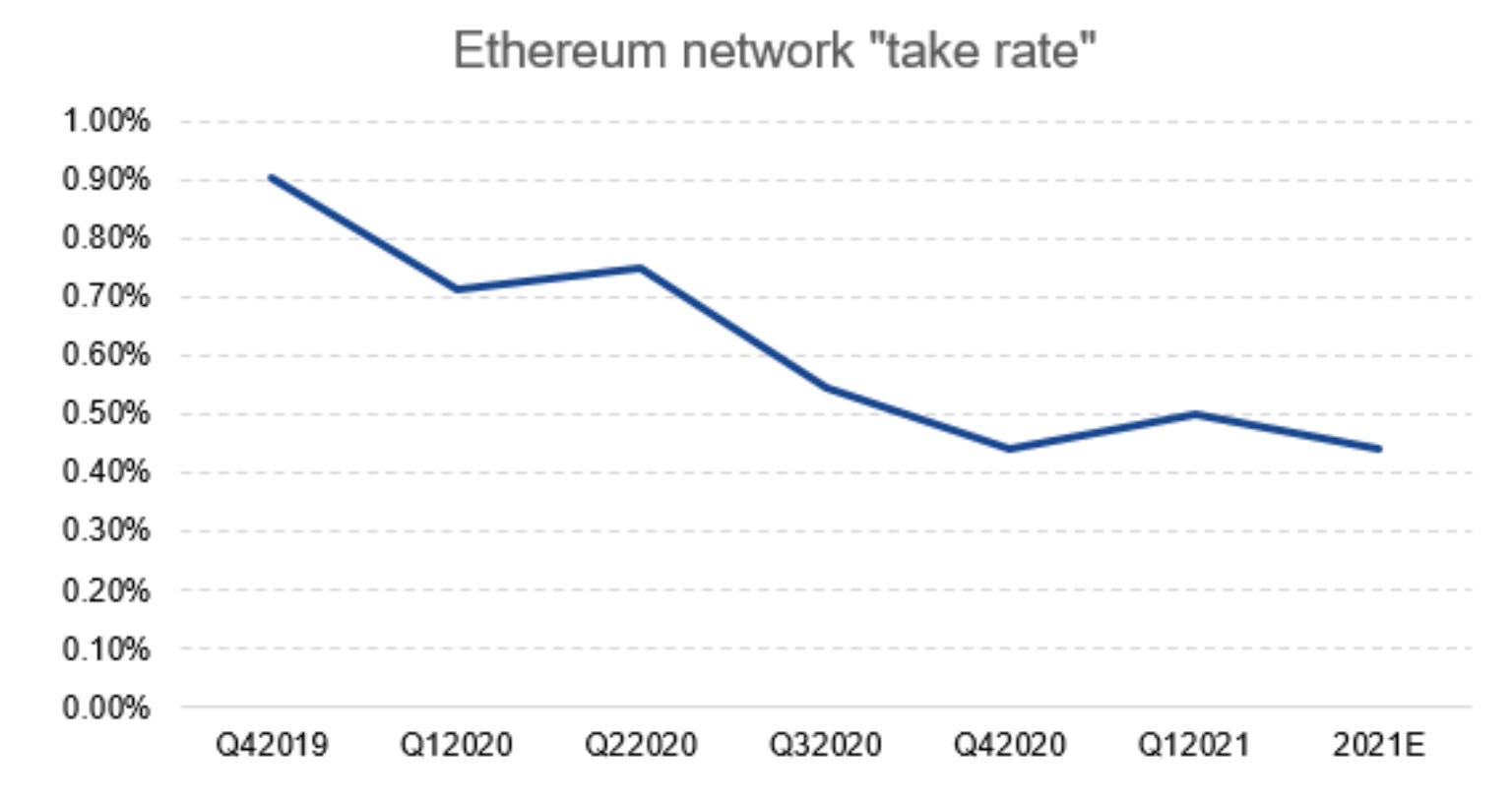
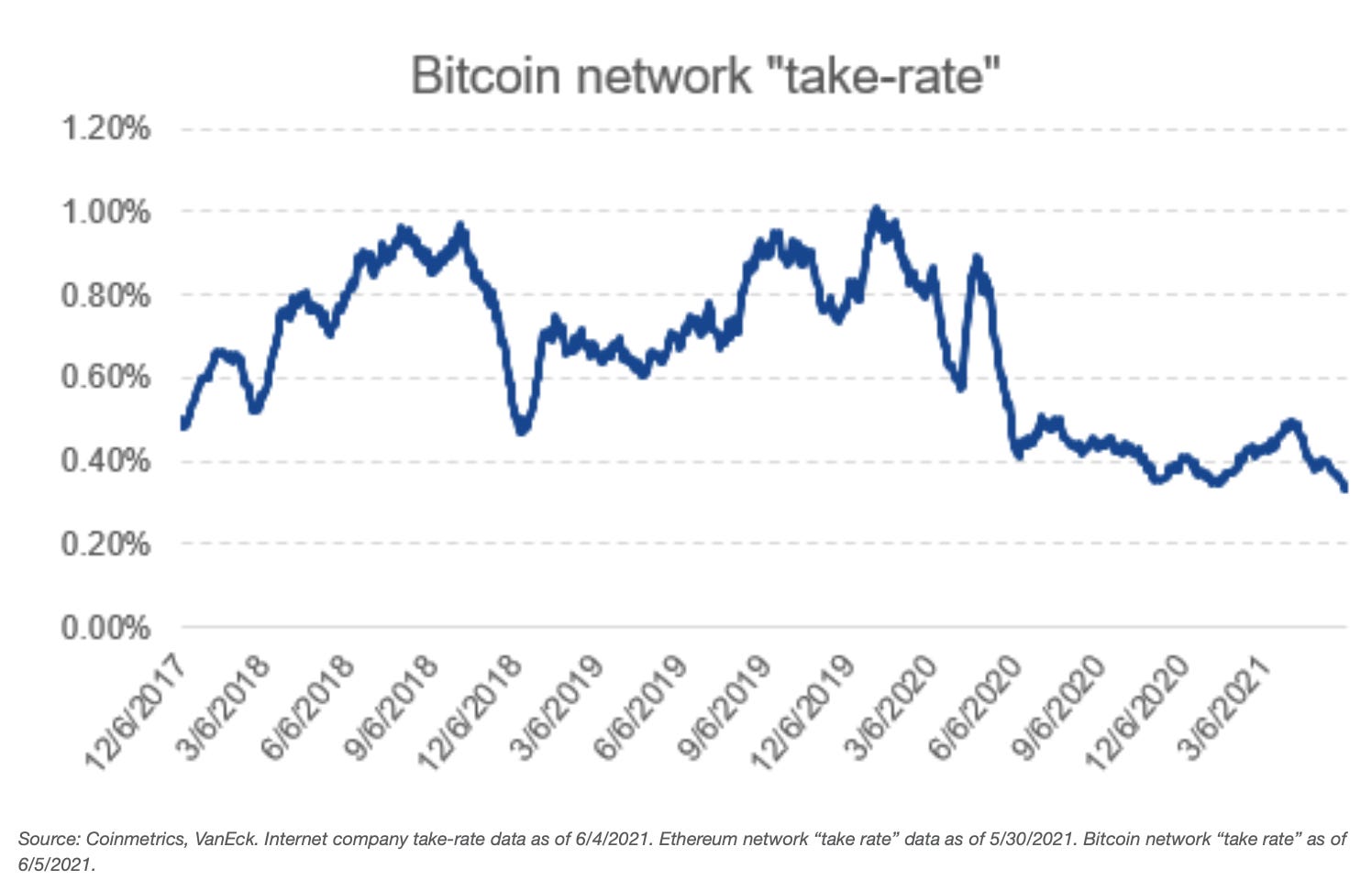
From Sigel, “the math is compelling: Web 2.0 firms charge 10-80% take-rates. Ethereum's is 50bps and falling. Bitcoin’s is even lower. Layer 2 scaling protocols Polygon and Arbitum claim to be 50 times cheaper than Ethereum”.
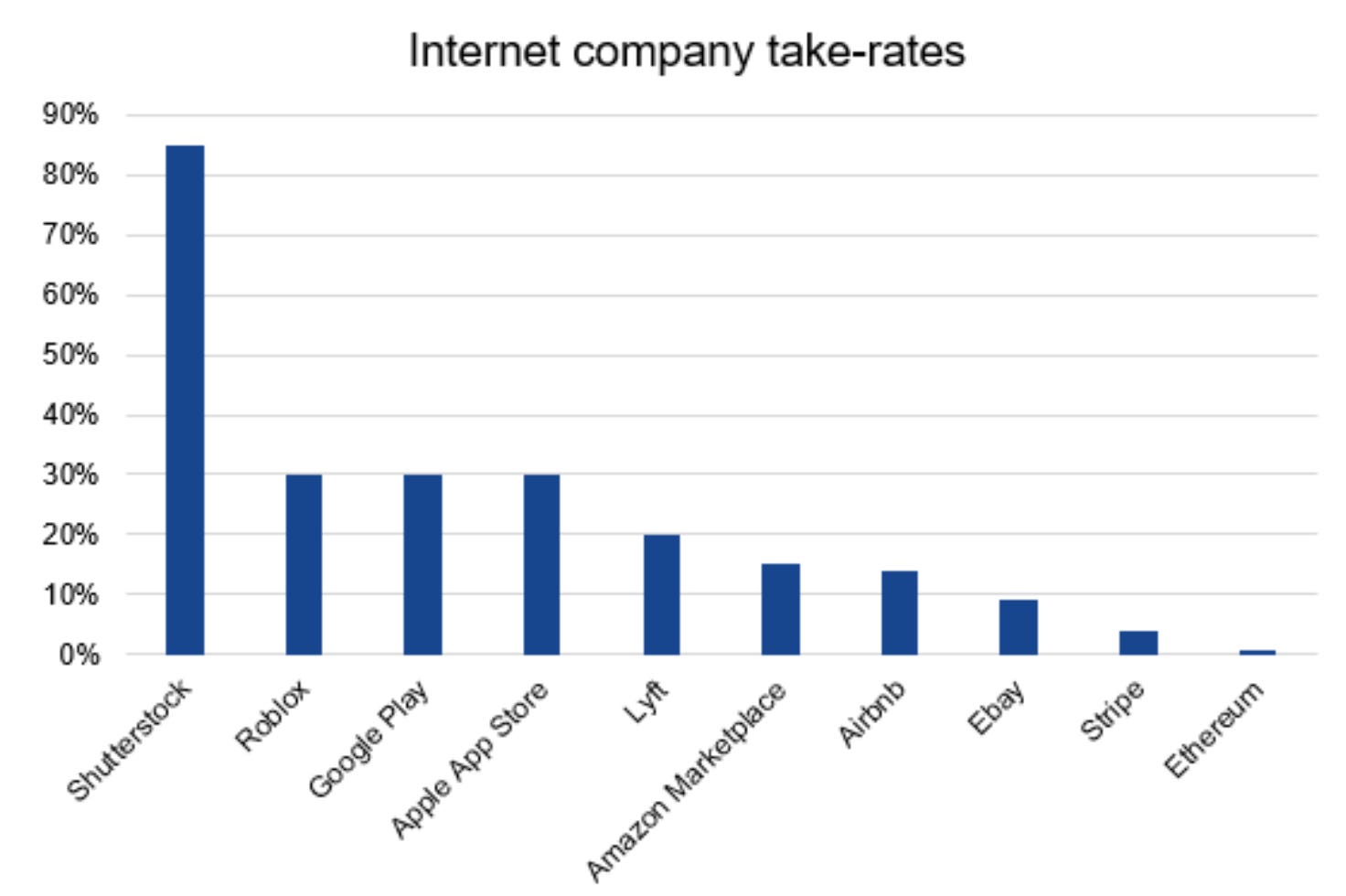
Ethereum take rate at approximately 45 basis points, see below.
And the Bitcoin network take rate is at approximately 30 basis points, see below.
How will legacy finance companies compete with such low cost alternatives? Right now it looks like there best hope is to keep the financial regulators on their side. But, the primary beneficiary of DeFi will be the end user, the consumer.
From Sigel, “It makes sense that open-source, all-digital solutions would prompt a race to the bottom on cost, and that is exactly what is happening. And while incumbents may end up losing more value than the combined positive "market cap" created by the winners, the balance should accrue to consumer welfare”.
Historically in the United States, the regulatory arc bends ever so slowly to the benefit of the consumer. It may take many, many years to defeat the Washington lobbyist, but ultimately DeFi will reshape finance in favor of the consumer.
I am spending ALL of my free time learning about this space. I think that the investment opportunities and outcomes will be massive.
CALIFORNIA DROUGHTS:
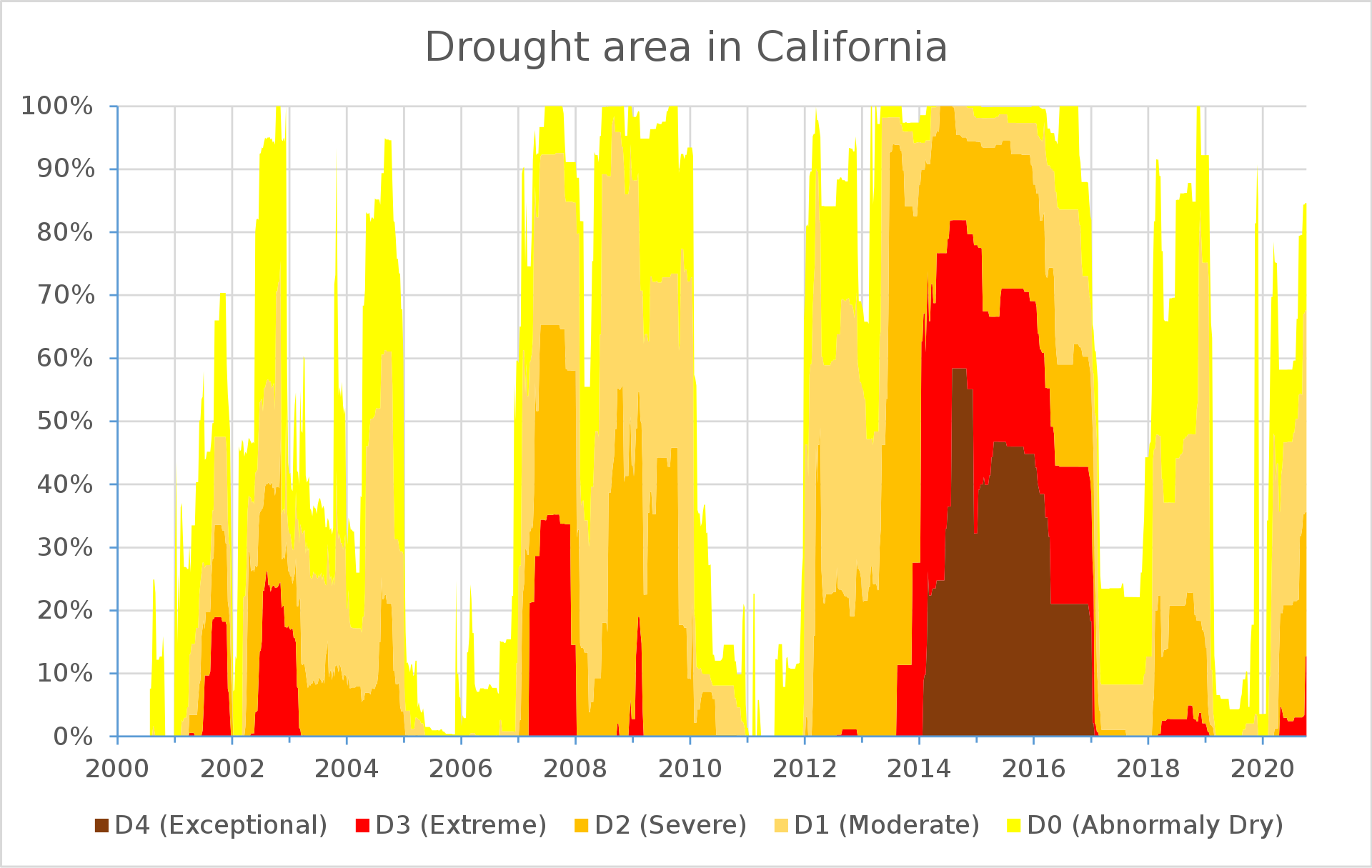
Once again, Californians are being told to conserve water, that we are about to be in another severe drought. This seems to be the case every other year, see below.
So how much water does the average Californian consume?
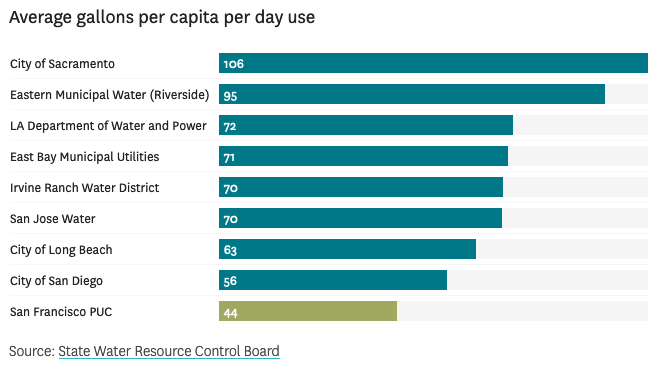
According to the San Francisco Chronicle the average Californian uses 102 gallons of water per day and in the Bay Area the averages are closer to 60 gallons per day. Urban water usage has been steadily declining for decades.
From the Public Policy Institute of California, “per capita water use has declined significantly—from 231 gallons per day in 1990 to 180 gallons per day in 2010—reflecting substantial efforts to reduce water use through pricing incentives and mandatory installation of water-saving technologies like low-flow toilets and shower heads”.
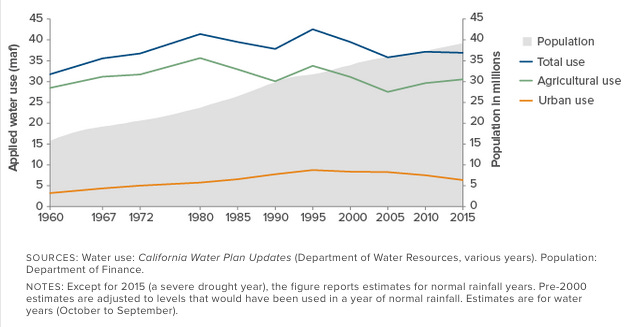
Even as the population has grown, water usage by both urban consumers and agriculture has declined. But, agriculture now accounts for about 80% of all water used for businesses and homes, see below.
It might be time for Governor Newsom and the politicians in Sacramento to think about how we can allocate water more efficiently between the citizens of California and the big corporate farms that make up only 2% of California’s GDP.
This week’s episode of Real Time with Bill Maher did a segment on the drought conditions in California. He pointed out that California does an extremely poor job of allocating water resources.
Specifically, almond farmers consume more water in California than ALL of populations and corporations in Los Angeles and the Bay Area combined!
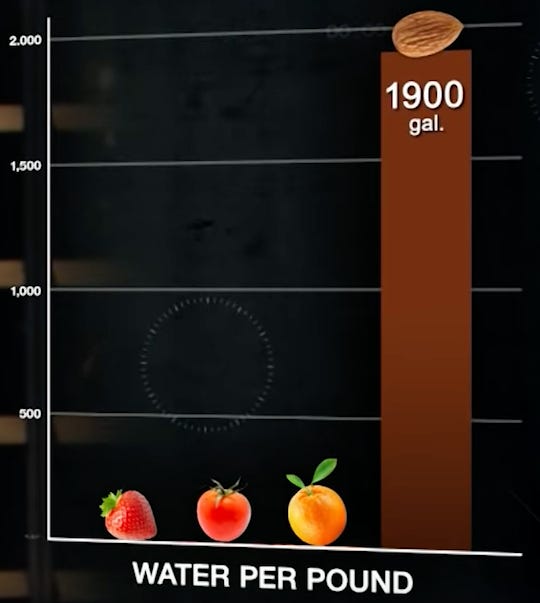
A pound of almonds requires 1,900 gallons of water. That compares to about 11 gallons for a pound of strawberries or oranges. And California produces 82% of the worlds almonds, one of the thirstiest crops in the world at a time when our reservoirs are running dry.
So where is Governor Newsom and the Sacramento politicians? California is the most highly regulated State in the United States with over 395,000 rules and regulations on the books. Maybe the politicians could study “Almonds” for the benefit of their citizens.
PODCAST:
Reason TV - U.S. Senator Cynthia Lummis Is All In on Bitcoin:
The Wyoming Republican says cryptocurrency will spur renewable energy, protect privacy, and possibly save the dollar. Lummis forcefully makes the case that bitcoin not only provides a legitimate alternative store of value and medium of exchange but will act as a check on the devaluation of the U.S. dollar and other currencies through the runaway creation of fiat money. She also believes that the growth of bitcoin—mistakenly assailed for its heavy use of electricity—is acting as a spur to create renewable energy in places such as Wyoming. Finally, she extolled blockchains privacy features in a world of increasing surveillance by governments and corporations.
Bitcoin Magazine - Bitcoin Conference 2021 in Miami:
Follow the link above to watch Day 1, Day 2 and various highlight sessions of the 2021 Bitcoin Conference held in Miami two weeks ago, this is the premier Bitcoin conference in the United States. While there were some sensational presentations meant to grab media headlines there were also many thought provoking session outlining the future of finance.
CONFERENCES:
As things slowly return to normal I am beginning to get back into speaking at and attending conferences. Here are a few on the docket, say hello if you are around.
ALTS CHICAGO 2021 - June 23-25 Artificial Intelligence, Bitcoin and DeFi
I’ll be closing out this conference with Matt Hougan the CIO at Bitwise, David Olsson from BlockFi and James Vermillion of Vermillion Private Wealth. We will be talking about AI applications in investing and Bitcoin and DeFi.
SILICON VALLEY BLOCKCHAIN SOCIETY - June 24
I’ll be providing a brief update to the community on the progress being made in the institutional investment world with regard to digital assets and DeFi applications.
Virtual Pension, Endowment & Foundation Summit - July 22 -
I’ll be on a panel discussing investment opportunities for institutions in the digital asset space. What are the areas that I am most excited about investing in today.
SALT Conference 2021 - September 12 - 15 in New York City
Milken Global Conference 2021 - October 17 -20 in Los Angeles
World Pension Summit 2021 - October 12 - 14, The Hague, Netherlands
I’ll be on Track A3 Asset Allocation and Investing: Fiat currencies may still be in our pockets, but is it time to put crypto in our portfolios? Is crypto viable or suitable for institutional investors? Can institutional investors help stabilize this market? How long will can crypto assets last?
I hope that you enjoy the letter as much as I enjoyed making it and please feel free to share the links with friends and associates and if you are interested in startups and are an accredited investor you can join over 750 other backers that follow my AngelList syndicate here.
Be well and stay safe. Sean Bill / MacroCrunch / Twitter
Agreed. DeFi will be center of gravity of investment and growth.
At a more structural level, will the more of the expected flow of VC investment into DeFi focus on:
A) more on funding development of more retail friendly (B2C) solutions, or
B) building out enterprise-grade DeFi ecosystems to support institutional customers with B2B on B2B2C offerings/products.
C) or something else?